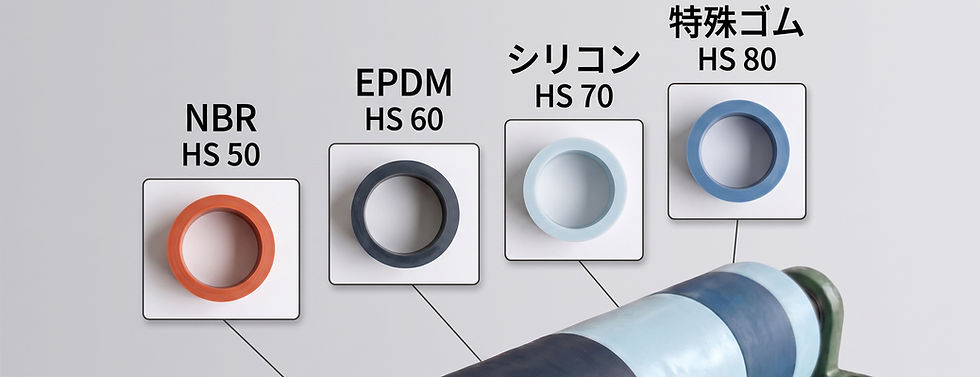
Expander Roll Starting Torque Changes Drastically with Rubber Hardness! Proprietary Technology for Stable Operation
- Osaka Senshoku Machinery Co., Ltd.
- 16 hours ago
- 3 min read
Expander rolls are indispensable for removing wrinkles from films and sheets in production lines. When operating them, a common challenge many customers face is the stability of the "starting torque" (the initial force required to rotate the roll).
Did you know that a mere 10° difference in the "synthetic rubber hardness" on the expander roll's surface can drastically change this starting torque?
The Proof is in the Data! The Impact of a 10° Difference in Hardness
First, please take a look at our actual measurement data. Below is the comparison data (reference values) of starting torque based on different rubber hardness levels under our actual test environment.
[Test Conditions (Reference)]
Size: Rubber outer diameter φ100 × Rubber face length 1500W
Specifications: Standard type for film
Material: NBR (Nitrile Rubber)
[Actual Starting Torque Values (using a spring scale)]
NBR 60° (Our standard hardness): 140g (Approx. 1.37N)
NBR 70°: 230g (Approx. 2.26N) As you can see, with an increase in hardness of just 10°, approximately 1.6 times more force is required to initiate rotation.
Why Does Torque Change Just by Hardness?
The reason lies in the "clamping force" of the rubber against the internal components.
Imagine a cylindrical part being tightly squeezed by rubber from the outside.
Naturally, squeezing it with hard rubber makes it much heavier to rotate the inner cylinder compared to using soft rubber. This is a basic physical principle.
Therefore, our expander rolls are set to "60° hardness" as a standard specification, making it easier to maintain an optimal starting torque.
The Barrier of "Rubber Characteristics" and "Environment" Beyond Catalog Specs
However, hardness is not the only factor that makes torque management difficult on the factory floor.
Due to the nature of rubber materials, even when manufactured with the same compound and hardness, the torque can delicately fluctuate based on slight manufacturing outcomes (rubber's unique characteristics and individual differences). Furthermore, the actual torque figures can go up and down significantly depending on the operating environment of your factory (such as room temperature and mechanical friction heat). With the structure of standard expander rolls, there has always been a persistent challenge: they cannot absorb the effects of these "rubber characteristics" and "environmental changes," inevitably leading to inconsistencies in rotational torque.
Why We Can Openly Share Our "Starting Torque Baseline Numbers"
Amidst environmental changes and individual rubber differences, how can we openly publish our starting torque figures?
It is because we possess proprietary technology that extremely precisely adjusts the "clearance" (gap) between internal components and the synthetic rubber during the manufacturing process. By assessing the specific traits of each piece of rubber and optimizing the tightening degree in microns to match its hardness, we can achieve a flawlessly stable starting torque.
We have absolute confidence in the precision and stability of our products. That is exactly why we openly share our numerical data—a practice quite rare in the industry.
For Those Struggling with Expander Roll Starting Torque
・"The starting torque of our current roll is too heavy, causing scratches on the film."
・"We want to use an expander roll with a specific, light torque."
・"We are looking for a roll that rotates stably even when environmental conditions change."
If your company has such requests or faces severe operational challenges, please contact Osaka Senshoku Machinery Co., Ltd.
Rather than forcing standard catalog specs upon you, we will utilize our years of expertise and proprietary clearance adjustment technology to propose the "optimal specifications" tailored to your site's environment. Through the introduction of our expander rolls, we will strongly support the stable operation of your production line.
We look forward to hearing from you.
[Contact Us]