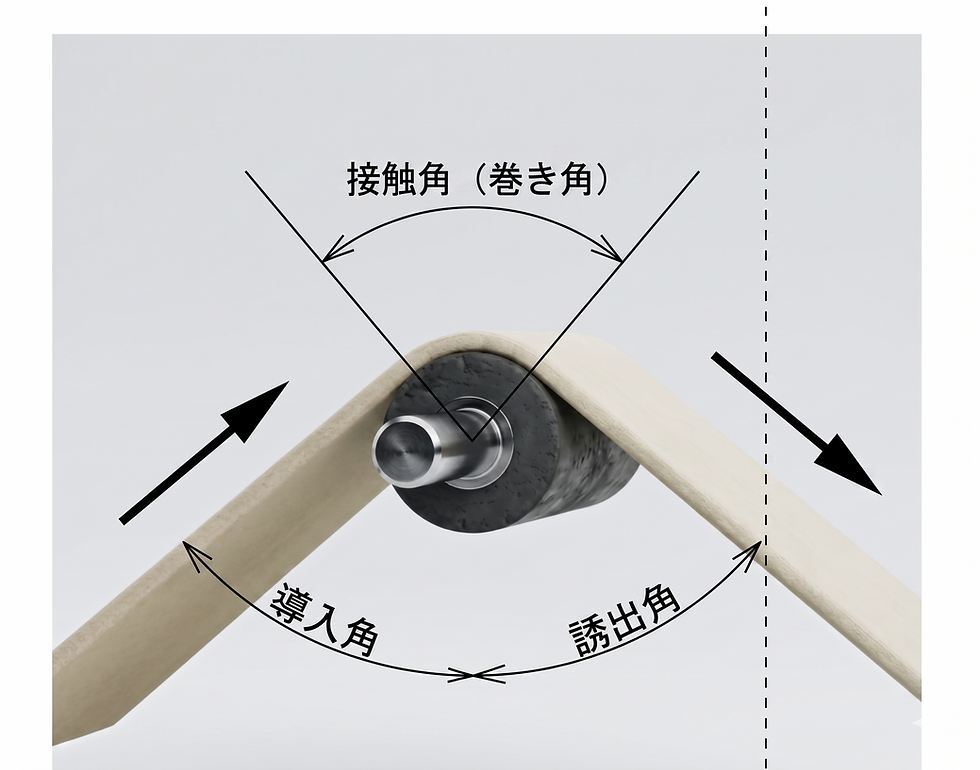
[Technical Guide] Correct Contact Angle (Wrap Angle) Settings for Expander Rolls and Recommended Values by Material
- Osaka Senshoku Machinery Co., Ltd.
- Apr 27
- 3 min read
"I installed an expander roll, but the wrinkles aren't being removed effectively..."
"I started a new production line with new materials, but I don't know the correct angle settings."
Are you facing these challenges on your production floor?
The key to maximizing the wrinkle removal and web expansion effects lies in the proper expander roll contact angle (wrap angle) of the sheet against the roll. lies in the "contact angle" (wrap angle) of the sheet against the roll. As a pioneer of expander rolls in Japan, Osaka Senshoku Machinery Co., Ltd. explains the importance of contact angles and provides recommended settings for different materials.
Why the Contact Angle Determines Wrinkle Removal Effectiveness
Expander rolls remove wrinkles by utilizing the lateral expansion of the roll surface as the sheet moves from the "concave side" to the "convex side". To efficiently transfer this spreading motion to the sheet, it is essential to maintain an appropriate contact angle.
If the contact angle is too shallow, the spreading force will not be transmitted. Conversely, if it is too deep, it can cause other issues. As a fundamental rule, always ensure the sheet enters from the concave side and exits toward the convex side.
Recommended Contact Angles for Expander Rolls by Material (Reference Values)
The optimal contact angle varies depending on the thickness and flexibility of the substrate. The following values are general guidelines based on our extensive track record and technical standards.
Category | Substrate / Material Type | Recommended Contact Angle (Reference) |
Film & Foil | PP/PA Film (1–6μm) | 60° – 90° |
PP/PA Film (8–20μm) | 45° – 60° | |
PP/PA Film (Over 20μm) | 45° | |
Metalized Film | 15° – 20° | |
Paper & Pulp | Paper / Board | 15° – 30° |
Forming Fabric | 20° – 25° | |
Press Wire | 20° – 40° | |
Wet Felt | 30° – 60° | |
Textiles | General Fabrics | 45° – 60° |
Elastic/Stretch Fabrics | 60° – 90° |
Note: The actual optimal angle fluctuates depending on line tension, conveyance speed, and the distance between adjacent rolls.
Caution! Contact Angles Over 90 Degrees Are Often Ineffective
It is a common misconception that "wrapping the sheet more tightly will remove more wrinkles," leading some to set angles as deep as 120 or 180 degrees. However, this often has the opposite effect.
Why is more than 90 degrees not recommended?
Due to the characteristics of bowed rolls, once the sheet passes the "convex apex," it enters a "contraction zone" where the roll surface begins to shrink back toward the center. This creates a force that pulls the already-expanded sheet back inward, significantly reducing the wrinkle removal effect and sometimes even creating new wrinkles.
Use "Flat Type" for Applications Requiring Deep Contact Angles
If your line design requires a large path line bend (where distance between rolls is limited) or if you must wrap the sheet deeply under high tension, the Flat Expander Roll is highly effective.
The Flat Type operates on the principle of the elastic body itself expanding and contracting laterally. Unlike bowed rolls, it is not limited by a "contraction zone," allowing for stable expansion even under the harsh conditions of deep contact angles.
Ensure Reliable Results Through Professional Selection
The values provided here are general guidelines. Relying solely on "trial and error" or makeshift adjustments on the shop floor may not lead to a fundamental solution and could result in costly material loss or decreased production efficiency.
"Is this angle truly correct for my setup?"
"Which is better for my material: the Bowed type or the Flat type?"
To achieve stable quality and reliable wrinkle removal, precise product selection and implementation by web handling experts are indispensable.
At Osaka Senshoku Machinery Co., Ltd., we evaluate your specific site conditions based on over 70 years of technical data to propose and design the optimal expander roll specifications. Before material loss occurs, please consult us regarding your wrinkle issues or new line startups.